
Something has quietly shifted in how Indian banks and insurers talk to their customers. The IVR menus are getting shorter. The hold music is disappearing. And increasingly, the voice on the other end of the line sounds less like a robot - and a lot more like someone who actually understands you.
Voice AI has been around for years. But for most of that time, it was more frustration than feature - stiff scripts, broken accents, and the inevitable "I'm sorry, I didn't catch that." Customers learned to mash zero and demand a human. And honestly, who could blame them?
That era is ending. What's replacing it is something genuinely different: AI voice agents that can hold natural conversations, understand intent, handle interruptions - and do it all in the language the customer actually speaks. For BFSI, this isn't a small upgrade. It's a fundamental rethink of what customer engagement can look like at scale.
The Numbers That Made the Industry Pay Attention
India's BFSI sector serves over a billion people. But the infrastructure built to serve them was designed for a much smaller, much more English-fluent audience. The gap between who these institutions serve and how they communicate has always been large. Now there's data to put a number on it.
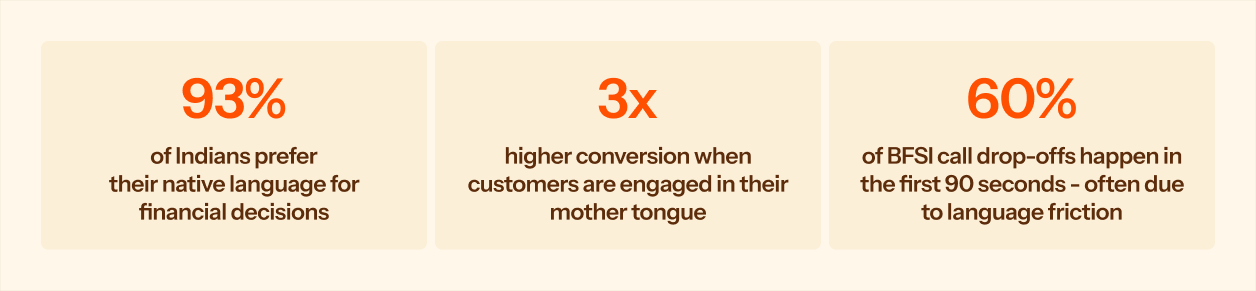
These aren't abstract figures. They show up in renewal rates, collection recovery, NPS scores, and lead conversion data. The language gap has always been a business problem. It's only recently that the solution has become viable at scale.
How Voice AI Got Here - A Quick Timeline
To understand why multilingual AI agents matter now, it helps to see how fast the underlying technology has moved.
Rule-based bots dominate
Scripted IVR trees, limited to fixed responses. One language. Zero flexibility. Customers hate it.
NLP enters the picture
AI starts understanding intent, not just keywords. Still mostly English, still often wrong.
Large language models change everything
Conversational AI becomes genuinely natural. Context, nuance, and follow-up questions handled gracefully.
Multilingual voice AI reaches enterprise grade
Low latency, dialect awareness, code-switching, compliance-ready. The technology enterprises actually need.
Why Multilingual Was the Missing Piece for India
India is not one market. It's dozens of markets layered on top of each other, each with its own language, dialect, and communication style. A policyholder in rural Bihar and a salaried professional in Bengaluru are both your customers - but they need to be spoken to completely differently.
For years, the standard answer was to hire more agents across language pools. Expensive, hard to scale, and inconsistent in quality. Multilingual AI changes the equation entirely - one system, trained across languages, available 24/7, with no quality degradation at volume.
Where BFSI Is Seeing Real Results
Multilingual voice AI isn't theoretical anymore. Across banking, insurance, and lending, early adopters are already measuring the impact.
Policy renewals
AI agents calling in the customer's language drive significantly higher pick-up and renewal rates compared to English-only outbound.
Lead qualification
Prospects from Tier-2 and Tier-3 cities engage longer and convert better when the AI speaks their language from the first second.
Collections & reminders
Payment reminder calls in the borrower's native language see measurably better response rates and lower dispute volumes.
Claims & support
Customers explaining a claim in their mother tongue are clearer, calmer, and less likely to escalate - better for everyone.
The Adoption Curve Is Accelerating
Voice AI adoption in Indian BFSI is no longer in the "pilot project" phase. The question has shifted from "should we explore this?" to "how fast can we deploy?"
Estimated voice AI adoption in Indian BFSI (% of enterprises actively deploying)
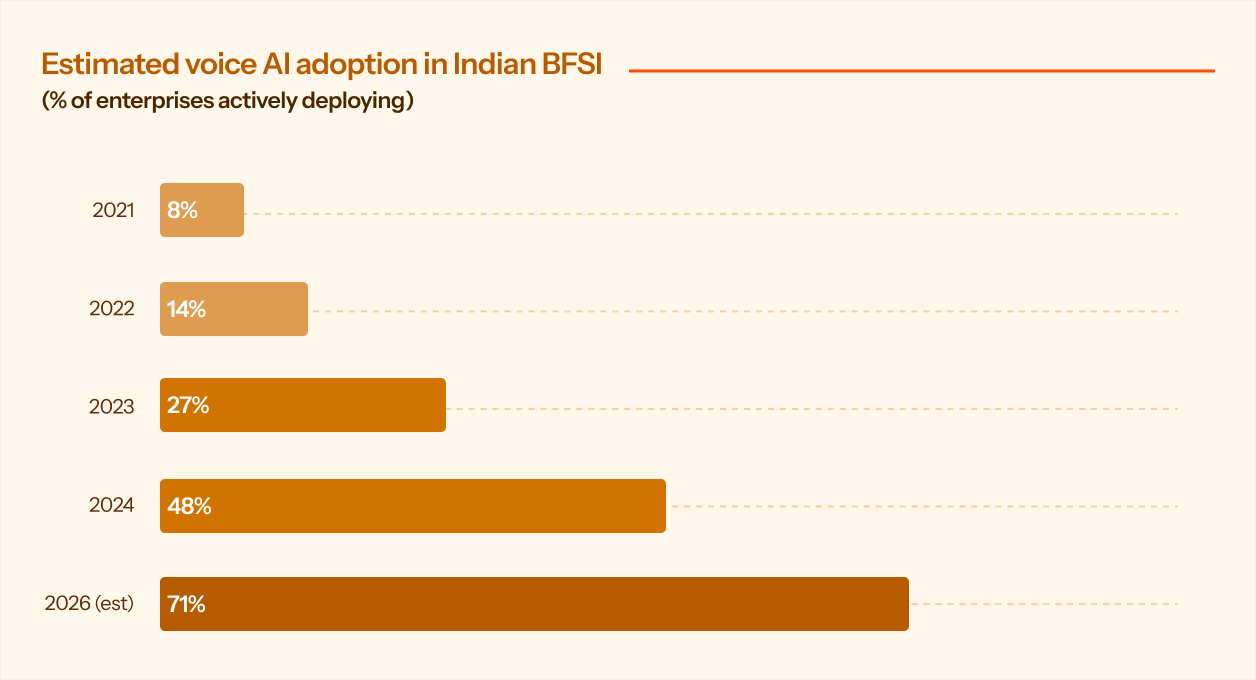
The inflection point was 2023 - when LLM-powered voice AI became good enough to deploy in production without embarrassing the brand. Since then, adoption has nearly tripled. And multilingual capability has been the single biggest driver of that acceleration in the Indian market.
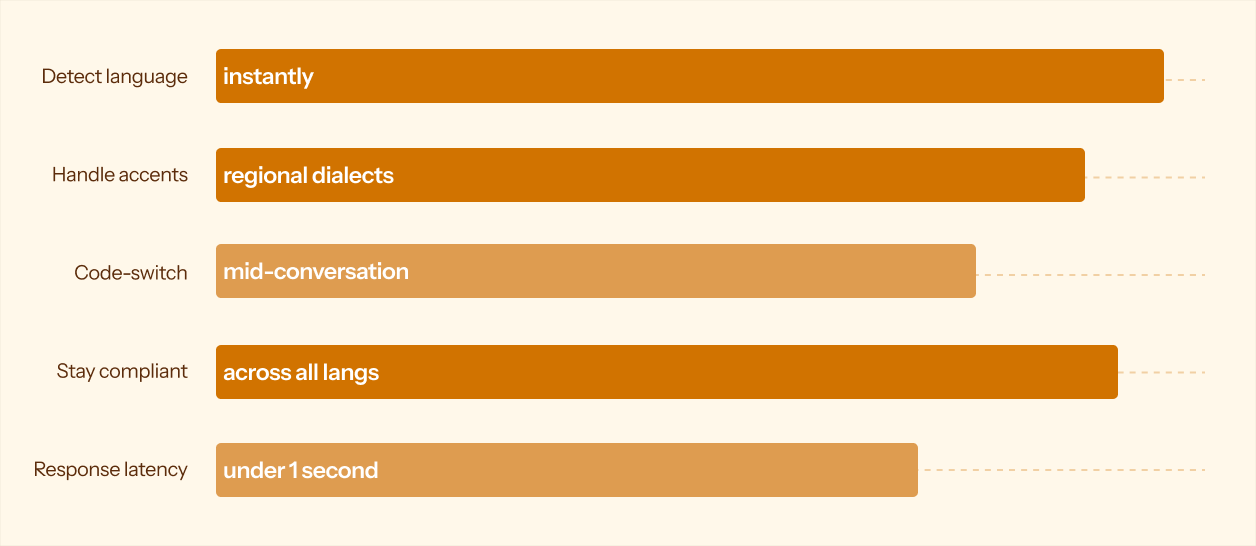
What Good Looks Like in 2026
The benchmark has moved. A good multilingual AI voice agent today should be able to:
The Window to Be Early Is Still Open
Most BFSI enterprises are still in evaluation mode. They're running pilots, reviewing vendors, waiting to see how competitors move. That window - where being an early mover still gives you a real advantage - won't stay open long.
The institutions that deploy multilingual voice AI in the next 12 months will build something their competitors can't easily replicate: customer relationships built on trust, in the right language, at scale. That's not a technology advantage. That's a customer loyalty advantage.
The rise of multilingual AI agents isn't a future trend to watch. It's a present-tense shift already underway. The only question left for BFSI leaders is whether they're leading it - or catching up to it.